
Equal in Dignity and Responsibility: Ministering to Those With Same-Sex Attraction

040715A conference is being planned in August to ponder an authentic pastoral response in ministering to those with same-sex attraction. Dr. Janet Smith is the organizer; Courage International and the Archdiocese of Detroit are the sponsors. It looks to be a  fine gathering of solid speakers. Though I am clearly a “back-bencher” among the fine speakers being lined up, I was asked to submit a paper for possible inclusion in the book that will likely be published by Ignatius Press just prior to the conference.

As a kind of followup to yesterday’s post, I would like to publish a draft of the paper I submitted (Dr. Smith has permitted this). It is only a draft, but I have tentatively titled it “Equal in Dignity and Responsibility.”  In it I explore some of the pastoral challenges and opportunities presented in ministering to those with same-sex attraction. Since the article is rather long (3500 words) I include a link to the PDF in case you would prefer to print it and  read it later (Equal in Dignity and In Responsibility).

Equal in Dignity and Responsibility: A Pastoral Consideration of Ministering to Those With Same-Sex Attraction 

The very public emergence of those among us with same-sex attraction and other self-described orientations presents many pastoral challenges for the Church. To a large degree much of this public emergence has taken up the premise that those with same-sex attraction have been victims of unjust discrimination and unequal treatment. The charges of inequality and injustice are also laid at the feet of the Church.

In this article I would like to argue that the Church does not treat those with same-sex attraction unfairly, either in terms of her teachings or her expectations. On the contrary, we insist on one standard for every person: to live chastely according to our state in life. For the married man and woman this means being faithful to each other in body, mind, and heart. For the unmarried, living chastely means refraining from all genital sexual activity, immodest touching, and lustful thinking rooted in pornography and/or masturbation. There are no exceptions to this standard, which is rooted in a biblical vision and in natural law. This one standard is just and equitable in that it binds all and blesses all. That those with same-sex attraction cannot marry someone to whom they are sexually attracted is unfortunate (there are many unfortunate factors in life), but there are also many who do not have same-sex attractions who for various reasons are not married and may never marry.

As a pastoral stance in ministering to those with same-sex attraction and in addressing our culture, it would seem wise that the Church emphasize the equanimity of our teaching, since allegations of unfairness and discrimination are pervasive. We have one standard and one teaching that is for all and applies to all without exception. We are all equal in dignity and responsibility.

This stance is also helpful in terms of how we handle the increasingly complex situations presented to us. Simply put, we should handle these situations in the same way we handle irregular situations involving heterosexual persons. One standard exists and must be applied to all. We ought learn to see these complex situations more simply and to apply our norms equitably to those who present them to us. They are equal in dignity and equal in responsibility.

Below we will apply this principle in four pastoral examples. But first we do well to examine a couple of things in the culture that make the task of demonstrating our equanimity more difficult.

The first matter is the notion of reducing one’s identity to one’s sexual attraction. Sexuality is an important component of who we are, but surely it is not the only component or even the most significant one. Yet in a hyper-sexualized culture there are increasing numbers who want their sexual attraction to be front and center, and who see this facet as almost the sole way they want to be understood. Never mind that they may like classical music, or be a car mechanic, or even a child of God. Many want to be known first and foremost as “gay” and be identified with a behavior that both Scripture and human tradition see as deeply problematic and sinful.

I leave it to other authors to develop the case for why it is problematic and sinful. The main point here is that if people identify sexual orientation as central to their identity, then they are bound to take very personally the rejection of the behavior with which they identify. This presents special challenges to us who say that we reject the sin but not the sinner.

But this is all the more reason that we in the Church must emphasize the equanimity of our teaching and strive to ensure that our policies reflect what we teach: that all are equal in dignity and responsibility; all are called to live according to the one chaste standard articulated in Scripture and Tradition.

The second matter is the rapidity of the change, the revolutionary quality of the issue. Less than ten years ago our current president spoke against so called gay “marriage” and suffered no political harm; he may even have benefitted from his stance. Even in a generally liberal state like California, a bill to approve marriage for same-sex couples was struck down in 2008. Since that time dramatic changes in the perception of those with same-sex attraction and in attitudes toward recognizing their unions as “marriages” can only be called stunning. Almost overnight, demands, now even coupled with threats of legal sanctions, have been directed at the Church to conform and regularize approval at every level for same-sex activity, same-sex  “marriages,” and so forth.

Here is the special challenge presented by issues related to same-sex attraction: its sudden appearance on the scene with a “take no prisoners” approach. The message seems to be this: “Comply quickly or experience condemnation, possible legal action, and/or being labeled unkind, intolerant, and ‘homophobic’.”

This rapid change of climate is important to acknowledge because to some extent it also helps explain why our simple, equal standard for everyone is not up and running in every diocese. There are many complicated rules and exceptions that seem to set up, which are interpreted as either unfairly targeting those with same-sex attraction, or as bending over backward to make exceptions for them in a way that compromises the moral requirements of Scripture and Tradition.

In contrast other matters such as single motherhood, divorce and remarriage, and cohabitation (all “common” sins among heterosexuals) showed up more subtly and gradually over the course of several decades. First there was one “single mother” and we handled it quietly; then there were a few, then dozens, and so on. But this occurred over time, decades. The awareness that we had a problem was (sadly) very slow in coming. The same can be said for cohabiting couples and for divorce and remarriage. In these cases as well, the effects extended over a longer period time, disguising the fact that we had a real problem on our hands.

Some with same-sex attraction claim that it was only when they appeared on the scene that the Church suddenly concluded we were in a crisis. I believe this is a fundamentally unfair accusation. I do, however, understand what has given rise to this charge. For decades now “divorce and remarriage” has gone on with relative silence from Catholic pulpits. Cohabitation, fornication, contraception, and pornography are also seldom the subject of sermons or statements from the Church. But enter gay “marriage” and suddenly it would seem the hierarchy has awakened and statements, court briefs, and other concerns abound. The “gay community” is cynical that our level of outrage is consistent across these issues. Fifty years of heterosexual misbehavior and redefining of marriage (through no-fault divorce and contraception) have seemingly been ignored. But the sleeping giant of the Church suddenly awakens when homosexual misbehavior appears. Or so the charge goes.

There are priests and bishops who have consistently preached against all sexual misconduct and spoken about the complex issues of divorce, but in general our pulpits have been too silent.

Our stance now cannot be to continue or deepen our silence but must be to proclaim without ambiguity the one chaste standard that binds and blesses us all. Bishops, priests, and deacons who preach on issues related to same-sex attraction must carefully present it as part of a whole teaching. I do not think I have ever preached or taught on the sinfulness of homosexual acts without also laying out the sinfulness of fornication and adultery. No one is or should be singled out. The point is that there is one standard.

If we have been sleepy and silent, shame on us. But the task before us now is to be clear, consistent, and charitable, announcing equal dignity and equal responsibility to follow the one standard for sexuality and marriage given to us all by God.

Some in the Church will also argue, with proper concern, that homosexual acts are not only sins against purity but also sins contrary to nature (St. Paul calls them “paraphysin” (Rom 1:26-27)) and that Scripture consigns them to the category of sins that “cry to heaven for vengeance” (cf Gen 17:20-21). And this is true and surely valid in a theological discussion.

But from a pastoral point of view, fornication, adultery, and homosexual acts are all serious violations against purity and are all objectively immoral. None of these acts can be reconciled with a proper understanding and living of the Catholic faith. Pastorally and practically when such situations arise in our parishes and schools, the decisions we make about giving sacraments, accepting children in our schools, employment issues, etc. are going to be handled in a similar manner.

As we go forward, I would argue that this is the key We must do a better job of presenting our objections to issues related to same-sex attraction in the light of our received teachings on sexuality, teachings that bind and bless everyone equally. There are not different standards for homosexual and heterosexual persons, neither are there different versions of human nature at work. Sexuality has a proper purpose and place; this vision, given to us by God and Natural Law, applies to all of us without exception.

Having set forth the principles of equality and simplicity, and having acknowledged the difficulties of the current climate, let’s look at some real-life situations and see how our teachings, properly applied, are fair and respectful to all involved.

Scenario 1: Two men present an infant they have adopted for baptism. The men are living in a same-sex relationship and have had their “marriage” recognized by the State. They claim to be parishioners and the pastor does recognize them, though he never knew of their relationship, living arrangements, or the existence of their civil “marriage” license. In the baptism of infants and young children there is to be some well-founded hope that the child will be raised in the Catholic faith (cf Canon 868.2). This highly irregular situation makes the pastor wonder as to the proper course of action.

Reply: In a fairly straightforward way, this scenario can be handled like that of a cohabiting heterosexual couple or a couple in an invalid marriage. When irregularities exist in the presenting family, the pastor must balance the fundamental need of the child for baptism with the likelihood of him or her actually being raised in the faith given those irregularities.

Some irregularities, such as validating a marriage, can be easily resolved; others cannot. Some cohabiting couples are planning to marry, but for others marriage is either not in the near future or is unlikely to occur at all. The faith of some heterosexual couples is vigorous despite the irregularities, but for others their faith is tepid and their practice of it is tangential to their lives.

And then there is the large number of single mothers presenting children for baptism. Some have had a one-time fall, others are prone to promiscuity or serial relationships that are unhealthy. Some are actively practicing their faith; many are not.

And yet here is a child in need of baptism. Given the urgent need for baptism, the historical tendency of the Church has been to baptize even the children of prostitutes. The “well-founded” hope that children will be raised in the faith has more often been understood to mean even a glimmer of hope. The fact is, whatever the irregular situation, the parent(s) are coming to the Church and requesting baptism. That means there is some faith.

Some pastors are far more restrictive in their interpretation, but the usual and historical stance has been to be generous in seeing a well-founded hope, given the necessity of baptism for salvation.

My own approach in cases of irregularities among heterosexuals is to use this as a teachable moment, a call to repentance; I use it as an opportunity to summon the parent(s) to faith. I don’t just stay silently “nice. ” I exhort cohabiting couples to separate if reasonable and not deleterious to the child.  I tell them that they should prepare to marry if this is advisable, and that they should most certainly stop fornicating right away. I tell those in invalid marriages that they should be validated. I tell those who are not coming to Mass to do so faithfully starting right away.

I also instruct them that they are going to be making a promise to God (and I read it right from the baptismal rite) to raise their children in the faith. This means that they cannot go on living in a way that is at odds with that faith. I ask them to soberly consider whether they are really ready to make this promise (which includes working to eliminate the irregularities). I tell them that if they are not, they should delay the baptism. It is difficult to imagine how they can avoid being sentenced to Hell if they fail to follow through on such a promise; I am very clear with them on this.

I would not change a thing with a same-sex couple. It is unlikely that I would refuse to baptize the child. However I would make it clear that they, too, have a decision to make in terms of the promise they will make to God. If they are going to raise this child in the Catholic faith, like any cohabiting couple, they need to stop having sexual intimacy, possibly separate entirely, and most certainly never teach the child that homosexual acts are anything other than sinful, as God’s Word teaches. If they are not able to make these changes and begin to conform to Catholic teaching (which their promise in the baptismal rite indicates) I recommend they delay the baptism until they are ready. But the decision is theirs.

In cases where baptisms involving any of the irregular situations described above go forward, I recommend that every parish handle them discreetly. In other words, celebrate them more privately, at times other than Masses or regularly scheduled baptisms. They ought not to be done alongside baptisms where properly married parents present their children. If such a practice has developed it should be discontinued so that further scandal and desensitization to irregularity are avoided. The baptism of a child presented by a same-sex couple at Mass or alongside proper situations would shock most congregations. And while unmarried heterosexual parents at baptisms are less apparent (and so cause less shock) these sorts of baptism also ought to be done more discreetly.

This may mean more work for clergy, but it must be done going forward if we are to assert, as I think we ought, that those with same-sex attraction are treated with equanimity.

Scenario 2: A reliable parishioner has reported to the pastor that a long-time, popular teacher in the parish school has begun living with a same-sex partner. How should the pastor deal with this situation?

Reply:  No pastor should ever handle such a situation alone. Consultations with the diocese and with legal staff are important in any decision that results in the termination of employment. Even apart from matters related to same-sex attraction, hiring and firing have become highly litigious matters. Clear evidence, including an interview with the teacher, must be assembled. Policies and procedures will have to be carefully followed.

There are also different expectations of those in roles of teaching and ministry as compared to other staff such as maintenance employees. Given the complexities, a pastor or principal who foresees a possible termination of employment must never do this alone at any stage; the diocese should be consulted.

However, from a moral standpoint, how is the situation described above any different from a teacher openly living together with her boyfriend? We reasonably expect the teachers in our Catholic schools not to live in open opposition to the teaching of the Church. If perchance a teacher has a disagreement with our teachings, we cannot force him or her to believe, but we can rightly insist that he or she remain discreet and not openly support or do what the Church teaches against. This applies to every person and to all our doctrinal teachings equally. So again, equality is essential. The standard is the same for heterosexual persons and homosexual persons.

Several major dioceses in this country have already undertaken measures to spell out reasonable norms and apply them equally to all teachers. Such norms have also been carefully crafted to avoid legal challenges and to respect the civil and constitutional rights of employees, even as the Church legitimately seeks to ensure that our schools hand on the faith in word and deed.

Scenario 3: A known lesbian couple” want to enroll their adopted daughter in kindergarten at the parish elementary school. The principal approaches the pastor for guidance. Perhaps it will good for the child to be in be in a religious environment where the Church’s teachings on marriage and the family are upheld. But perhaps, too, it could cause harm to the other children who would be exposed to a confusing situation that might imply the Church’s approval.

Reply: Here, too, no pastor or principal should ever handle this alone. A proper and equitable response is going to require a diocesan-level decision that is followed in all our schools. Different schools with different policies convey the message that the teaching is really up for grabs or that it just represents personal opinion.

A situation like this occurred recently in a large archdiocese in this country. The diocese had reason to suspect that homosexual activists may have orchestrated this as a “set up” since three same-sex couples all applied at once, to three different schools in the archdiocese.

The archdiocese convened a panel of pastors, principals, legal experts, and others to consider the applications and develop a response to them and a policy going forward.

The solution was essentially to place the matter squarely in the hands of the applicants. Application forms for every school were enhanced to indicate that, in enrolling their children in the archdiocese’s Catholic schools, parents were expected to live in a way that did not express opposition to Catholic moral teaching. Currently they are asked to sign a statement certifying that they can meet this requirement. This puts the onus on the applicant and does not require principals and pastors to go down some sort of checklist that, no matter how long, might be called selective and be subject to the parsing of every word.

Again, everyone is treated equally: equal in dignity, equal in responsibility.

Scenario 4: A student preparing for the Sacrament of Confirmation has just publicly supported same-sex marriage. After ongoing discussions, his pastor advises him that he is not ready to receive the sacrament and should delay it until he can resolve his differences with the Church. Further, the student intends to make public the intervention by his pastor, according to his side of the story.

Reply: Confirmation is a Sacrament of Initiation given by the Lord to strengthen one in the proclamation of the Faith. As such, those who are confirmed publicly affirm the Creed and by extension whatever truths the Catholic Church believes, teaches, and proclaims to be revealed by God. The public support of same- sex marriage is directly contrary to biblical and Church teaching. Hence the student would, in effect, be publicly lying were he to proceed with the Rite of the Sacrament of Confirmation. Nothing is being denied the student. He is excluding himself from being able to receive the sacrament since he does not share the faith in which he seeks to be confirmed. Further, unlike baptism, confirmation is not necessary for salvation.

The student is free to make public his side of the story and to relate what the pastor said. The pastor is not free to report what the student said in their meetings but he can issue a generally worded statement about what confirmation is (and what it is not) and what the recitation of the Creed means in the context of the celebration of the sacrament.

This might also allow the pastor an opportunity to teach the congregation that the reception of Holy Communion each Sunday also involves an affirmation of communion with the Church and with her doctrinal and moral teachings.

So the priest can use this as a teaching moment but would be advised not to allow the matter to be reduced to the questions surrounding same-sex attraction. Instead this can permit him to apply the principle of equality and remind all Catholics to seek communion with the Church on all matters, doctrinal and moral.

So again, here is a clear application of the principle of equanimity wherein Church teaching on matters related to same-sex attraction is seen in the light of wider teaching that applies to all.

In summary, though a new landscape confronts us, our teachings have not changed. They continue to apply to all equally. We do not single out certain groups or acts for special condemnation or praise. In such matters as our moral teaching on human sexuality and the call to purity, no one is exempt; no one exists in a special category. There is one Lord, one Faith, one Baptism. It applies to us all; it binds us all; it blesses us all. We stand before God as equals. We all receive the grace to be holy whatever temptations particularly assail us, whatever sinful attractions draw us. We are equal in dignity and responsibility.
What Effect Will Pressure to Accept Same Sex Acts or "Marriage" Have on Church Teaching? None!

040615Last week was Holy Week, so sure enough there were many critical issues in the news that needed attention but we in the Church were off doing more important things like worshipping God and pondering our need for salvation. Permit a brief summary and some predictions from me based on the latest unpleasantness in Indiana last week.

I am not a lawyer and neither know nor understand all the legal implications of the law signed by the Indiana governor and then later amended. I speak more to the cultural concerns raised by same-sex attraction, the redefinition of marriage in civil justification, and the rapidity of all of these things and how they affect the Church.

Regarding cultural concerns and the political landscape, as is often the case, Ross Douthat summarizes the situation best:

One of the difficulties in this discussion, from a conservative perspective, is that the definition of “common sense” and “compromise” on these issues has shifted so rapidly in such a short time: Positions taken by, say, the president of the United States and most Democratic politicians a few short years ago are now deemed the purest atavism [a recurrence of or reversion to a past style, manner, outlook, or approach, something strikingly archaic], the definition of bigotry gets more and more elastic, and developments that social liberals would have described as right-wing scare stories in 2002 or so are now treated as just the most natural extensions of basic American principles. … But the pace involved is unusual, and its rapidity makes it very easy to imagine that scenarios that aren’t officially on the table right now will become plausible very, very soon. the only remaining question in the same-sex marriage “debate” [is] what kind of space, if any, an ascendant cultural liberalism would leave to Americans with traditional views on what constitutes a marriage. … [T]he choice of exactly how far to push and how much pluralism to permit would [seem to] be almost entirely in the hands of liberals and supporters of same-sex marriage. That’s … basically how it looks to me today. [1]

Indeed, as an “American with traditional views on what constitutes a marriage” it is hard not to feel bullied and outgunned. Most of our opponents feel secure politically, culturally, and legally  in labeling us the worst sort of bigots and threatening legal sanctions. It is not merely that we must be “pitied” or considered “out-of-date”; we must be removed from the scene or forced to comply. The high horses are out in force and those who ride them seek a clean sweep of all who utter so much as a word of dissent. I wonder with Terry Mattingly if the horses would be quite so high if a “gay” Episcopalian caterer refused to cater a convention of “ex-Gay” Americans; outrage and coverage thereof by the mainstream media might be very selective.

From the few reports I heard, it seems many reporters are poor at distinguishing Catholic views from those of some (not all) Evangelicals. The Catholic position distinguishes same-sex attraction from same-sex behavior (i.e., homosexual acts) in ways that many Evangelicals do not. We should not countenance any business turning a “gay” American away simply because he or she is known to be “gay.” And I do not know anyone who says that someone should be turned away simply because he or she self-identifies as “gay.” That would be unjust discrimination, which the Catechism speaks against.  However, when a Catholic is asked to contribute to or benefit from an event that celebrates same-sex acts or same-sex “marriage,” the situation is much different.

There are some situations in which a Catholic business owner’s cooperation/participation in such an event would be remote and thus not construed as approving sinful activity. In such cases the owner can proceed with a clear conscience. However, when cooperation in such an event would indicate support or approval of what Scripture and the Church teach as sinful, Catholics have duties and rights to stand back and not cooperate. To some degree there are prudential judgements involved in determining what constitutes remote vs. direct material cooperation. However, the norm remains: Catholics should not directly materially cooperate in doing what is sinful or wrong in any matter, be it issues of invalid marriages, illicit sexual union, or any number of other moral issues forbidden by Scripture and Church teaching.

For the record, this is the Catholic position on same-sex attraction is stated in the Catechism:

Homosexuality refers to relations between men or between women who experience an exclusive or predominant sexual attraction toward persons of the same sex. It has taken a great variety of forms through the centuries and in different cultures. Its psychological genesis remains largely unexplained. Basing itself on Sacred Scripture, which presents homosexual acts as acts of grave depravity, [Cf. Gen 191-29; Rom 124-27; 1 Cor 6:10; 1 Tim 1:10], tradition has always declared that “homosexual acts are intrinsically disordered.” [CDF, Persona humana 8]. They are contrary to the natural law. They close the sexual act to the gift of life. They do not proceed from a genuine affective and sexual complementarity. Under no circumstances can they be approved. 

The number of men and women who have deep-seated homosexual tendencies is not negligible. This inclination, which is objectively disordered, constitutes for most of them a trial. They must be accepted with respect, compassion, and sensitivity. Every sign of unjust discrimination in their regard should be avoided. These persons are called to fulfill God’s will in their lives and, if they are Christians, to unite to the sacrifice of the Lord’s Cross the difficulties they may encounter from their condition. 

Homosexual persons are called to chastity. By the virtues of self-mastery that teach them inner freedom, at times by the support of disinterested friendship, by prayer and sacramental grace, they can and should gradually and resolutely approach Christian perfection (Catechism 2357-2359).

This teaching is not going to change no matter how much pressure this latest cultural juggernaut brings to bear. Individual Catholics [and even some bishops] may cave in to the pressure, but the teaching cannot and will not change; it is firmly held in the sacred deposit of faith and consistently taught by the Magisterium.

But as for the Church, I think predictions of our demise (if we do not comply with current social pressures) lack historical understanding. More specifically, many say that if we don’t update our teachings on same-sex attraction, contraception, divorce and remarriage, etc. we are going to become “irrelevant” and our pews will empty. I have a few thoughts on these gloomy predictions:

1. The Catholic Church has endured 2000 years of “social pressure” to change almost every one of our teachings, dogmatic and moral. Consider the Judaizers of St Paul’s day. Consider the Trinitarian and Christological heresies of the first few centuries. Consider the great Eastern Schism of the 11th century. Consider the Soteriological and Ecclesiological errors of the 16th Century. Consider modernism in our own time and all its offshoots such as relativism, discontinuity, reductionism, scientism, deconstructionism, and any other “ism” you can think of that takes one thing and makes it the whole thing. But here we still are. Empires have come and gone, nations have risen and fallen, philosophies and fancies have been tried and found wanting. Here we still are. Where are Nero, Julian the Apostate, Napoleon, Marx, and Stalin? Where is the USSR? All these political forces, people, and movements had an agenda they pressured us to adopt. They are gone and the Church and the Gospel are still here. All flesh is like grass and all its glory like the flower of grass. The grass withers, and the flower falls, but the word of the Lord remains forever” (1 Peter 1:24-25). And from Luke, Heaven and earth will pass away, but my words will never pass away. So, be careful, or your hearts will be weighed down with carousing, drunkenness and the anxieties of life, and that day will close on you suddenly like a trap (Luke 21:33-34). So this age has its agendas and is warning the Church that she will fade and die if she does not conform. I think I’ve heard that one before!

2. The denominations that have adopted the “give the people what they want” stance (be it women clergy, approval of abortion, approval of homosexual acts, approval of gay “marriage,” etc.) are far emptier than is the Catholic Church, which by the way continues to grow worldwide. Surely secularism has taken a toll on the Church in many parts of the country, especially the old cities of the Northeast. But in the South many parishes are bursting at the seams and new parishes are being built. Most of the old, mainline Protestant denominations that have taken the “be relevant and permissive” advice are now quite divided and increasingly empty, whereas Catholic parishes and Evangelical denominations that have resisted this (though the Catholic position distinguishes attraction from sinful acts) are either holding their own or growing.

3. Many say that the Catholic Church’s own members do not follow Catholic teachings on sexuality. This is true in varying degrees depending on the specific area. But many also do not follow our teaching against greed. Very few confess it and many seem to think it never applies to them. Should we change this teaching? Many fail to be as generous as they should be to the poor and very few confess this. Perhaps this teaching should be set aside as well since it doesn’t seem very popular and the poor are still with us. And boy, I’ll tell you a lot of Catholics struggle with the forgiving thing and loving their enemy! When forgiveness is preached many think that they have a good reason not to forgive and that God will understand in their particular case. So is it out with forgiveness, too?  And despite many decades of dissent and scoffing at her teaching on contraception, the Church has not changed her position and it looks more right than ever given the confusion that contraception has caused about the purposes of sex. Right now our culture’s big obsession is with sexual misbehavior and thus the demands that we change the ancient, tested, biblical teaching on sexuality loom large. But when the current madness is finished or (more sadly) this culture exits the scene (by sexual suicide) the Church will still be here and the Gospel will remain unchanged.

4. Despite the charges against her of bigotry and unfairness, the Catholic Church has one standard for everyone based on Scripture: chastity. (I will write more on this tomorrow.) For the married this means fidelity of mind, heart, and body. For the unmarried it means no genital sexual contact, ever. Those of same-sex attraction may protest that marriage is not possible for them under our teaching. This is true unless they are able to develop an attraction to the opposite sex. But even many who are not same-sex attracted either delay marriage significantly or never find a suitable marriage partner. They might object to simply being told that they have “options.” And frankly, as a vowed heterosexual celibate, I find objectionable the notion that living without sexual intercourse is worse than a death sentence. My life is full and happy. I have good friendships and can say firsthand that the Lord and the Church do not ask too much of the unmarried to refrain from sexual intimacy. Such a continence is not impossible. In the 26 years of my vowed commitment, I have never strayed with anyone, not even once. So the Church has one standard for everyone. And this is a sign of respect that is in contrast to the “soft bigotry” that would ask less of someone because he or she has an attraction that does not conform to the purposes of sexual activity.

The Church does have work to do in reaching out to those of same-sex attraction with a message of compassion that does not contradict the truth of God as revealed in Scripture and Natural Law. In August I will be attending a conference organized by Dr. Janet Smith that seeks to address this very task. Though I will be a mere “back-bencher”  among many fine scholars and clerics, I was asked to submit a paper on pastoral challenges related to same-sex attraction. I will present excerpts from that paper tomorrow on the blog.

Meanwhile, I would like Cardinal George to have the last word. Please pray for the good Cardinal, who is currently hospitalized with extensive cancer. Always so careful but clear, Cardinal George writes,

 In recent years, society has brought social and legislative approval to all types of sexual relationships that used to be considered “sinful.” Since the biblical vision of what it means to be human tells us that not every friendship or love can be expressed in sexual relations, the Church’s teaching on these issues is now evidence of intolerance for what the civil law upholds and even imposes. What was once a request to live and let live has now become a demand for approval. The “ruling class,” those who shape public opinion in politics, in education, in communications, in entertainment, is using the civil law to impose its own form of morality on everyone. We are told that, even in marriage itself, there is no difference between men and women, although nature and our very bodies clearly evidence that men and women are not interchangeable at will in forming a family. Nevertheless, those who do not conform to the official religion, we are warned, place their citizenship in danger [1].

Amen. More tomorrow on our need as a Church to present an effective response at the parish level to the cultural challenges related to same-sex attraction.

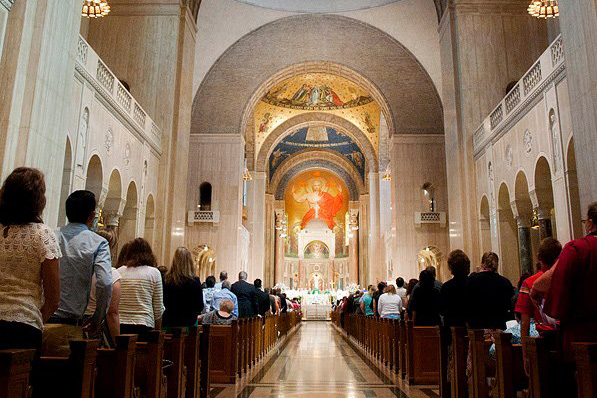
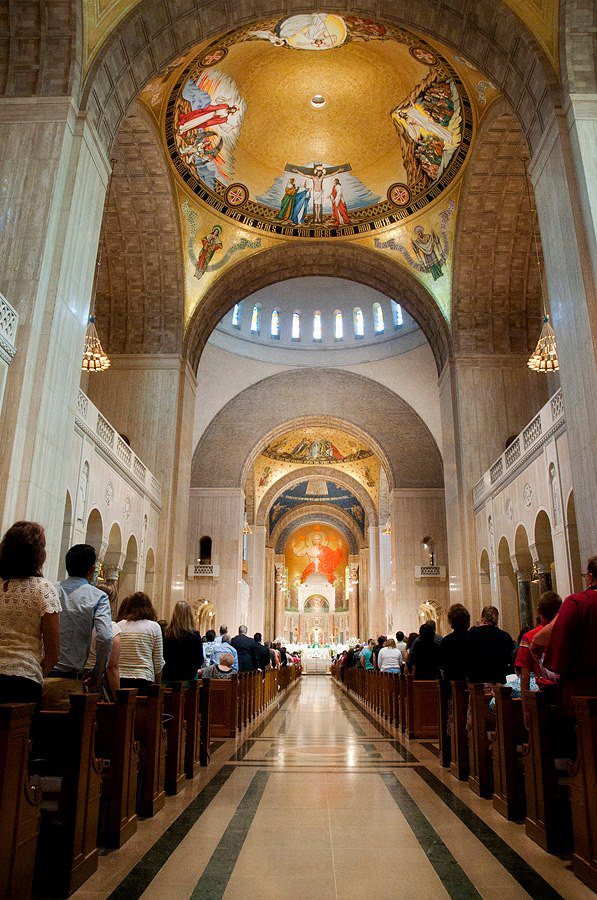
The photo above is of St. John Cathedral in Indianapolis.

The Resurrection Appearances "Chronologically" Arranged

040515-AToday’s post is a follow-up to yesterday’s blog.

When we encounter the resurrection accounts in the New Testament, we face a challenge in putting all the pieces together in such a way that the sequence of events flows in logical order. This is due to the fact that no one Gospel presents all or even most of the information. Some of the accounts seem to conflict. I have opined before (HERE) that these apparent conflicts are usually not in fact true conflicts. Another difficulty with putting all the facts together in a coherent manner is that the timeline of the events is unclear in some of the accounts. Luke and John are the clearest as to the timing of the events they describe; Matthew and Luke give us very few parameters. Both Acts and Paul also supply accounts in which the timeline is not always clear.

Nevertheless, I want to propose to you a possible, dare I claim even likely, sequence of the resurrection events. The work is my own and I make no claim that this scenario is certain or backed up by recognized ancient authority. St Augustine has done quite a lot of work in this matter and you can read that by clicking HERE. My proposition here is simply the fruit of 25+ years of praying over and pondering the events of those forty days between the Lord’s resurrection and His ascension. My reflections are based as solidly as possible on the Bible, with a sprinkling of speculation.

I realize that my attempt to do this will irritate some modern biblical scholars who seem to insist that it is wrong to attempt any synthesis of the texts since the authors intended no such synthesis.

Nevertheless, I press on boldly, hoping that the average believer will benefit from it and find such a synthesis interesting. Take it for what it is: the work of an obscure pastor who has prayed and carefully sought to follow the sequence of the forty days. You may wish to offer correction or an alternative interpretation; I encourage you to do so in the comments. I have posted a PDF of this document here: The Resurrection Appearances Chronologically Arranged.

In this year’s version I have included hyperlinks to the biblical texts so that you can simply click on them to read the text and then press back to return here.

  • I. The morning of day one
    • A. Very early in the morning a group of several women, including Mary Magdalene, approach the tomb to complete burial customs on behalf of Jesus (Matt 28:1; Mk 16:1; Jn 20:1).
    • B. They behold the tomb opened and are alarmed.
    • C. Mary Magdalene runs off to Peter and John with the distressing news of likely grave robbers (Jn 20:2).
    • D. The women who remain at the tomb encounter an angel, who declares to them that Jesus has risen and that they should tell this to the brethren (Mk 16:5 Lk 24:4; Mt 28:5).
    • E. At first the women are filled with fear and depart from the tomb afraid to speak (Mk 16:8).
    • F. Recovering their courage they decide to go to the Apostles (Lk 24:9; Mt 28:8).
    • G. Meanwhile Peter and John go to the tomb to investigate Mary Magdalene’s claim. Mary follows behind them, arriving back at the tomb while Peter and John are still there. Peter and John discover the empty tomb; they encounter no angel. John believes in the resurrection; Peter’s conclusion is not recorded.
    • H. The other women report to the remaining Apostles what the angel at the tomb said to them. Peter and John have not yet returned from the tomb and these remaining apostles are at first dismissive of the women’s story (Lk 24:9-11).
    • I. Mary Magdalene, lingering at the tomb, weeps and is fearful. Peering into the tomb, she sees this time two angels who wonder why she weeps. Jesus then approaches her from behind. Not looking directly at Jesus, she supposes Him to be the gardener. When He calls her by name, Mary recognizes His voice, turns, and sees Him. Filled with joy she clings to Him (APPEARANCE 1) (Jn 20:16).
    • J. Jesus sends Mary back to the Apostles with the news to prepare them for His appearance later that day (Jn 20:17).
    • K. The other women have now departed from the Apostles and are on their way, possibly back home. Jesus appears to them (Mt 28:9) (after having dispatched Mary). He also sends them back to the Apostles with the news that He has risen and that He will see them (APPEARANCE 2).
  • II. The afternoon and evening of day one
    • A. Later that day, two disciples on their way to Emmaus are pondering what they have heard about rumors of Jesus’ resurrection. Jesus comes up behind them but they are prevented from recognizing Him. First Jesus breaks open the word for them; then He sits at table with them and celebrates the Eucharist, whereupon their eyes are opened and they recognize Him in the breaking of the bread (APPEARANCE 3) (Lk 24:13-30).
    • B. The two disciples return that evening to Jerusalem and go to the Eleven. At first the Eleven disbelieve them just as they had the women (Mk 16:13). Nevertheless they continue to relate what they have experienced. At some point, Peter draws apart from the others (perhaps for a walk?). The Lord appears to Peter (APPEARANCE 4)(Lk 24:34; 1 Cor 15:5). Peter informs the other ten, who then believe. Thus the disciples from Emmaus (still lingering with the Apostles) are now told (perhaps by way of apology) that it is in indeed true that Jesus has risen (Lk 24:34).
    • C. Almost at the same moment, Jesus appears to the small gathering of Apostles and the two disciples from Emmaus (APPEARANCE 5). Thomas is absent (although the Lucan text describes the appearance as being to “the eleven,” this is probably just shorthand for the Apostles as a group). They are startled but Jesus reassures them and opens the scriptures to them (Lk 24:36ff).
    • D. There is some debate as to whether He appeared to them a second time that night. The Johannine and Lucan accounts have significantly different descriptions of the appearance on that first Sunday evening. Is it merely a different recounting of the same appearance or is it a wholly separate appearance? It is not possible to say for sure. Nevertheless, since the descriptions are so different we can call it APPEARANCE 6 (Jn 20:19ff), though it is likely one and the same as “Appearance 5.”
  • III. Interlude
    • A. There is no biblical account of Jesus appearing to anyone during the week that followed. The next account of the resurrection says, “Eight days later,” namely the following Sunday.
    • B. We do know that the apostles exclaimed to Thomas that they had seen the Lord, but that he refused to believe it (Jn 20:24).
    • C. Were the apostles nervous that Jesus had not appeared again each day? We do not know; there are no accounts of what happened during this interlude.
  • IV. One week later, Sunday two
    • A. Jesus appears once again (APPEARANCE 7) to the gathered Apostles. This time Thomas is with them. He calls Thomas to faith, and Thomas now confesses Jesus to be Lord and God (Jn 20:24-29).
  • V. Interlude two
    • A. The apostles had received instructions to return to Galilee (Mt 28:10; Mk 16:7) where they would see Jesus. Thus they spent some of this interlude journeying 60 miles to the north, a trip that would have taken a considerable amount of time. We can imagine them making the trek north during the intervening days.
  • VI. Sometime later
    • A. The time frame of the next appearance is somewhat vague. John merely says “after this.” It is likely a matter of days or a week at best. The scene is at the Sea of Galilee; not all of the Twelve are present. They have gone fishing and Jesus summons them from the lakeside. They come to shore and see him (APPEARANCE 8). Peter has a poignant discussion with Jesus and is commissioned to tend the flock of Christ (Jn 21).
    • B. The Appearance to the 500 – Of all the appearances, you might think that this one would have been recorded in some detail since it was the most widely experienced. It would seem that many accounts would have existed and that at least one would have made its way into the Scriptures. Yet there is no account of it other than that it did in fact happen. Paul records the fact of this appearance in 1 Cor 15:6: Then he appeared to more than five hundred brethren at one time, most of whom are still alive, though some have fallen asleep (APPEARANCE 9). Where did this take place? What was it like? What was the reaction? We simply do not know. Proof once again that the Bible is not a history book in the conventional sense. Rather, it is a highly selective telling of what took place, not a complete account. The Bible makes no claim to be something it is not. It is quite clear that it is a selective book (Jn 20:30).
    • C. The Appearance to James. Here again we do not have a description of this appearance, only a remark by Paul that it did in fact happen 1 Cor 15:7: Then he appeared to James (APPEARANCE 10). The time frame of this appearance is not clear, only that it happened after the appearance to the five hundred and before the final appearance to the apostles.
  • VII. The rest of the forty days
    • A. Jesus certainly had other appearances to/with the disciples. Luke attests to this in Acts when he writes, To them he presented himself alive after his passion by many proofs, appearing to them during forty days, and speaking of the kingdom of God (Acts 1:3).
    • B. During this time there is perhaps the one appearance we can attribute specifically to this time period as recorded by both Matthew (Mt 28:16ff) and Mark (Mk 16:14ff). It takes place on “a mountaintop in Galilee.” Mark adds that they were reclining at table. I refer to this appearance (time frame uncertain) as APPEARANCE 11. It is here that Jesus gives the great commission. Although Mark’s text may seem to imply that Jesus was taken up from this mountain, such a conclusion is rash since Mark only indicates that Jesus ascended only “after he had spoken to them” (Mk 16:19).
    • C. Evidently Jesus had also summoned them back to Jerusalem at least toward the end of the period of the forty days. There they would be present for the feast of Pentecost. We can imagine frequent appearances with ongoing instruction, for Luke records that Jesus “stayed with them.” Most of these appearances and discourses are not recorded. Luke writes in Acts, And while staying with them he charged them not to depart from Jerusalem, but to wait for the promise of the Father, which, he said, “you heard from me, for John baptized with water, but before many days you shall be baptized with the Holy Spirit” (Acts 1:4).
  • VIII. The final appearance and ascension
    • A. After forty days of appearances and instructions we have a final account of the last appearance (APPEARANCE 12) wherein He leads them out to a place near Bethany and gives them final instructions to wait in Jerusalem until the Holy Spirit is sent. And then He is taken up to Heaven in their very sight (Lk 24:50-53; Acts 1:1-11).

So here is a possible, and if I do say so myself likely, chronology of the resurrection appearances. It is a synthesis that attempts to collect all the information and present it in a logical sequence. There are limits to what we can expect of the Scriptural accounts; fitting perfectly into a logical sequence is not what the texts primarily propose to do. Yet such a chronological sequence can prove helpful and it is in that spirit which I present it.

Here is a video I put together based on a song performed here at my parish on Good Friday. It is sung by one of our Sopranos, Marjorie Boursiquot. It is arranged by our director, Kenneth Louis, and composed by Long and Pote. The song is entitled “You Love Me.” Prepare yourself for a real treat!

The Journey from Fear to Faith – A Homily for Easter Morning

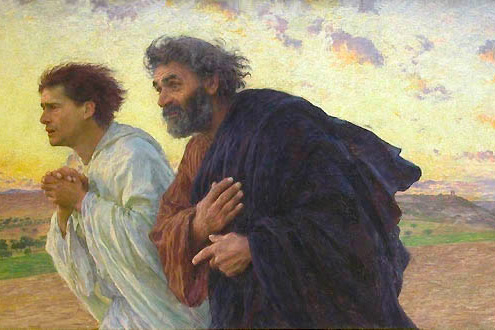
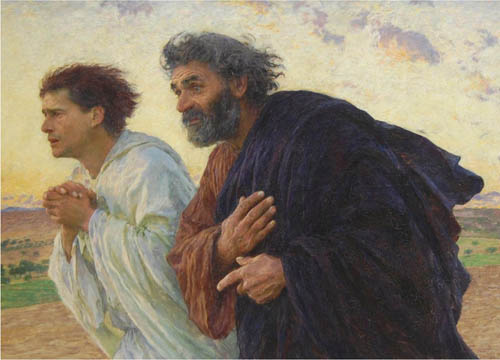
“Disciples running by EB” by Dougjenkinson – Own work. Licensed under CC BY-SA 4.0 via Wikimedia Commons.

One option for the gospel for Easter Sunday morning is from John 20:1-8. And like most of the resurrection gospels it paints a portrait of a journey that some of the early disciples have to make out of fear and into faith. It shows the need to experience the resurrection and then come to understand it more deeply.

I have blogged before on the Matthean gospel option for Easter Sunday morning (HERE). This year I present John’s. Let us focus especially on the journey that St. John makes from fear to faith. While the gospel begins with Mary Magdalene, the focus quickly shifts to St. John. Let’s study his journey.

I. REACTION MODE – The text begins by describing everyone as being in a reaction mode, quite literally running about in a panic! On the first day of the week, Mary of Magdala came to the tomb early in the morning, while it was still dark, and saw the stone removed from the tomb. So she ran and went to Simon Peter and to the other disciple whom Jesus loved, and told them, “They have taken the Lord from the tomb, and we don’t know where they put him.”

Notice that the text describes the opening moments as “still dark.” And it is likely that John is doing more than telling us the time of day. The deeper point is that there is still a darkness that envelops everyone’s mind.  The darkness makes it difficult for us to see and our fears and sorrows can blind us.

Notice also that she looks right at the evidence of the resurrection but presumes and concludes the worst: grave robbers have surely come and snatched the body of the Lord! It doesn’t even occur to her to remember that Jesus had said that He would rise on the third day and that this was that very third day. No, she goes immediately into reaction mode instead of reflection mode. Her mind jumps to the worst conclusion; by reacting and failing to reflect, she looks right at the blessing and sees a curse.

And often we do this, too. We look at our life and see only the burdens instead of the blessings.

  1. I clutch my blanket and growl when the alarm rings instead of thinking, “Thank you, Lord, that I can hear. There are many who are deaf. Thank you that I have the strength to rise; there are many who do not.”
  2. Even though the first hour of the day may be hectic: socks are lost, toast is burned, tempers are short, and the children are so loud; we ought to be thinking, “Thank you Lord, for my family. There are many who are lonely.”
  3. We can even be thankful for the taxes we pay because it means we’re employed, for the clothes that fit a little too snugly because it means we have enough to eat, for our heating bill because it means we are warm, for the weariness and aching muscles at the end of the day because it means we have been productive.

Every day millions of things go right and only a handful go wrong. What will we focus on? Will we look right at the signs of our blessings and call them burdens or will we bless the Lord? Do we live lives that are reactive and negative or do we live reflectively, remembering that the Lord says that even our burdens are gifts in strange packages. And we know that all things work together for good to them that love God, to them who are the called according to his purpose (Romans 8:28).

Do we know this, or are we like the disciples on that early morning, when it is still dark, looking right at the blessings but drawing only negative conclusions, reacting and failing to reflect?

II. RECOVERY MODE – The text goes on to describe a certain subtle move from reaction to reflection. So Peter and the other disciple went out and came to the tomb. They both ran, but the other disciple ran faster than Peter and arrived at the tomb first; he bent down and saw the burial cloths there, but did not go in.

We start in reaction mode. Notice how Mary Magdalene’s anxiety is contagious. She comes running to the apostles, all out of breath, and says that “they” (whoever “they” are) have taken the Lord (she speaks of Him as a corpse) and “we” (she and the other women who had gone out) don’t know where they put Him (again, she speaks of Him as an inanimate corpse). And Mary’s panic and reactive mode triggers that same reaction in the Apostles. Now they’re all running! The mad dash to the tomb has begun.

But notice that they are running to verify grave robbery, not the resurrection. Had they but taken time to reflect, perhaps they would have remembered that the Lord had said He would rise on the third day and that this was the third day. Never mind all that; panic and running have spread and they rush forth to confirm their worst fears.

But note a subtlety. John begins to pick up speed as he runs. And his speed, I would argue, signals reflection and hope. Some scholars say it indicates merely that he was the younger man. Unlikely. The Holy Spirit, speaking through John, is not likely interested in passing things such as youth. Some of the Fathers of the Church see a greater truth at work in the love and mystical tradition that John the Apostle symbolizes. He was the “disciple whom Jesus loved,” the disciple who knew and experienced that love of God. And love often sees what knowledge and authority can only appreciate and affirm later. Love gets there first.

There is also a Bible verse that I would argue decodes John’s  increasing strength as he runs:

But those who hope in the LORD will renew their strength. They will soar on wings like eagles; they will run and not grow weary, they will walk and not be faint (Is 40:31).

Perhaps John ran faster as he began to move from reaction to reflection and remembrance. When you run fast you can’t talk a lot, so you get alone with your thoughts. There is something about love that enlightens and recalls what the beloved has said. Perhaps John begins to think, to reflect and recall.

  1. Didn’t Jesus say He’d rise three days later?
  2. Isn’t this that day?
  3. Didn’t my Lord deliver Daniel?
  4. Didn’t He deliver Noah from the flood?
  5. Didn’t He deliver Joseph from the hands of his brothers and from the deep dungeon?
  6. Didn’t He deliver Moses and the people from Egypt?
  7. Didn’t He deliver David from Goliath and Saul?
  8. Didn’t He deliver Jonah from the whale?
  9. Didn’t He deliver Queen Esther and the people from wicked men?
  10. Didn’t He deliver Susanna from her false accusers?
  11. Didn’t He deliver Judith from Holofernes?
  12. Didn’t Jesus raise the dead?
  13. Didn’t He promise to rise?
  14. Didn’t God promise to deliver the just from all their trials?
  15. Ah! As for me I know that my redeemer liveth!

Something started to happen in John. And I have it on the best of authority that he began to sing in his heart as he ran,

“I don’t feel no ways tired. Come too far from where I started from. Nobody told me that the road would be easy but I don’t believe he brought me this far to leave me.”

Yes, John is in recovery now. He’s moved from reaction to reflection and he is starting to regain his faith.

The text says that he looked in and saw the grave clothes but waited for Peter. Mystics and lovers may get there first but the Church has a Magisterium that must be respected, too. John waits, but as we shall see, he has made his transition from reaction to reflection, from fear to faith.

III. REASSESSMENT MODE – In life, our initial reactions must often be reassessed as further evidence comes in. Peter and John must take a fresh look at the evidence from their own perspective. The text says, When Simon Peter arrived after him, he went into the tomb and saw the burial cloths [lying] there, and the cloth that had covered his head, not with the burial cloths but rolled up in a separate place.

Mary Magdalene’s assessment had been, in effect, grave robbers. But the evidence for that seems odd. Usually grave robbers were after the fine linens in which the dead were buried. But here are the linens and gone is the body! Strange.

And there is something even stranger about the linens. If it had been grave robbers they wouldn’t have taken the time to unwrap the body of valuable grave linens. The Greek text describes the clothes as κείμενα (keimena) – lying stretched out in place, lying in order. It is almost as if the clothes simply “deflated” in place when the body they covered disappeared!

Not only that, but the most valuable cloth of all, the σουδάριον (soudarion), is carefully folded. Grave robbers would not leave the most valuable things behind. And surely, even if for some strange reason they wanted the body rather than the linens, they would not have bothered to carefully unwrap and fold things, leaving them all stretched out in an orderly way. Robbers work quickly; they snatch and leave disarray in their wake.

Life is like this: you can’t simply accept the first interpretation of things. Every reporter knows that “in the fog of war the first reports are always wrong.” And thus we, too, have to be careful not to jump to all sorts of negative conclusions just because someone else is worried. Sometimes we need to take a fresh look at the evidence and interpret it as men and women of hope and faith, as men and women who know that though God may test us He will not forsake us.

John is now looking at the same evidence that Mary Magdalene did. But his faith and hope give him a different vision. His capacity to move beyond fearful reaction to faithful reflection is changing the picture.

We know little of the reaction of Peter or Mary Magdalene at this point; the focus is on John. And the focus is on you. What do you see in life? Do you see grave robbers? Or are you willing to reconsider and move from knee-jerk fear to reflective faith?

Does your resurrection faith make you ready to reassess the bad news you receive and look for blessings even in crosses?

IV. RESURRECTION MODE – And now, though somewhat cryptically, the text focuses on the reaction and mindset of St. John. Then the other disciple also went in, the one who had arrived at the tomb first, and he saw and believed. For they did not yet understand the Scripture that he had to rise from the dead.

At one level the text says plainly that St. John saw and believed. Does the text mean only that he now believed Mary Magdalene’s story that the body was gone? Well, as is almost always the case with John’s Gospel, there is both a plain meaning and a deeper meaning. The context here seems clearly to be that John has moved to a deeper level. The text says that he ἐπίστευσεν (episteusen); he “believed.” The verb here is in the aorist tense, a tense that generally portrays a situation as simple or undivided, that is, as having a perfective (completed) aspect. In other words, something has come to fruition in him.

And yet the text also seems to qualify, saying, they did not yet understand the Scripture that he had to rise from the dead. It is as if to say that John came to believe that Jesus had risen but had not yet come to fully understand all the scriptural connections and how this had to be. He only knew in his heart by love and through this evidence that Jesus was risen. Deeper understanding would have to come later.

But for our purposes let us observe that St. John has gone from fear to faith. He has not yet seen Jesus alive but he believes based on the evidence and on what his own heart and mind tell him.

At this moment John is like us. He has not seen but he believes. Neither have we seen, but we believe. John would see him alive soon enough and so will we!

We may not have an advanced degree in Scripture but through love we, too, can know that He lives. Why and how? Because of the same evidence:

  1. The grave clothes of my old life are strewn before me.
  2. I’m rising to new life.
  3. I am experiencing greater victory over sin.
  4. Old sins and my old Adam are being put to death.
  5. The life of the new Adam, Christ, is coming alive.
  6. I’m being set free and have hope and confidence, new life and new gifts.
  7. I have increasing gratitude, courage, and a deep peace that says that everything is all right.
  8. The grave clothes of my old way of life lie stretched out before me and I now wear a new robe of righteousness.
  9. I’m not what I want to be but I’m not what I used to be.

So we, like John, see. We see not the risen Lord, not yet anyway. But we see the evidence and we believe.

St. John leaves this scene a believer. His faith may not be the fully perfected faith it will become, but he does believe. John has gone from fear to faith, from reaction to reflection, from panic to peace. This is his journey and, prayerfully, ours too.

Jesus Is Real to Me! A Homily for Easter Sunday

040415Nearly all of the Resurrection accounts in the Gospels present the Apostles and disciples on a journey to deeper faith. In stages, they come out of the darkness of despair and of this world into the light of faith. Matthew’s account (28:1-10), which is read at the Easter Vigil this year and can also be read at Masses during the day, is no exception. I have also commented on the Johannine Gospel that is often read on Easter morning (From Fear to Faith).

Let’s look at the Easter journey that Mary Magdalene and Mary (likely, Mary the mother of James and Joseph) make out of darkness into light. Mark (16:1) adds that Salome, the wife of Zebedee and the mother of James and John, went with them. From Luke (24:10) it also appears that Joanna, wife of Herod’s steward Chusa, was with them. Hence, though Matthew only mentions two women by name, it would seem that our analysis should include these four women. As these women journey through the events of Easter morning we see their faith deepen and brighten. In a condensed sort of way, we see in this a microcosm of the whole life of the Christian. In a similar way we, journeying in stages, come to a deeper faith and a brighter vision of the Paschal mystery that is our life.

Let’s observe their journey in four stages.

Stage One – Disturbance at Dawn

After the Sabbath, as the first day of the week was dawning, Mary Magdalene and the other Mary came to see the tomb. And behold, there was a great earthquake; for an angel of the Lord descended from heaven, approached, rolled back the stone, and sat upon it. His appearance was like lightning and his clothing was white as snow. The guards were shaken with fear of him and became like dead men.

Note that in this first stage it is still quite dark. The text here says, with hope, that the new day was dawning. The Greek word actually used, however, properly means as the first day “approached” or drew on without specifying the precise time. Mark (16:1-2) says that it was very early in the morning (at the rising of the sun), that is, not that the sun “was risen” but that it was about to rise or that it was the early break of day. Luke (24:1) notes that it was “very early in the morning” (in the Greek text it was “deep twilight” or when there was scarcely any light). John (20:1) says that it was “very early, while it was yet dark,” that is, it was not yet fully daylight nor had the sun risen.

So the point is that it is still quite dark but dawn is near! And all this creates an air of great expectation for us who read the account. An old song in the Taizé Community says, “Within our darkest night, you kindle a fire that never dies away!”

Next, there is a great earthquake! Sometimes God has to shake things up to open new doors and new vision. And in our lives, too, there are often violent shakings. But remember, we are at the dawn of a new day. In just a few short years, if we are faithful, we’ll be with God. And so it is that this earthquake is not unto destruction but is unto the opening of the tomb that has claimed our Lord and unto the opening of tombs that have claimed us emotionally, spiritually, and mentally. This earthquake, frightening though it may seem, serves only to draw these women deeper into the Paschal mystery and toward the risen Christ.

Now notice that they haven’t seen him yet or even heard that he is risen; there is only this earthquake, but it has a purpose. Yet for now, it is barely dawn and things are still very unclear to them.

Stage Two – Declaration: Do Not Be Afraid

Then the angel said to the women in reply, “Do not be afraid! I know that you are seeking Jesus the crucified. He is not here, for he has been raised just as he said. Come and see the place where he lay.

Note that the angel summons them to deeper faith. He exclaims, “Do not be afraid.” Now to most of us this may seem to be almost a “throwaway” line, one we often hear when we are perceived by others to be anxious. And frankly, when others say this to us, it is both annoying and unhelpful. But in this case the angel presents a basis for their faith to grow and their anxiety to dissipate.

That they should not be anxious or afraid is firmly rooted in the Lord’s promise and in His Word. The angel is reminding them that the Lord had promised to rise on the third day, and that He has done just as He said. The Lord, who had raised others from death and healed multitudes, has now done exactly what He promised.

Hence, the angel summons them to grow in their faith by pondering the Word of Jesus Christ and by coming to trust in His promise.

The angel also presents evidence to them: the empty tomb. He invites them to connect the dots between the promise of Jesus and the present evidence of an empty tomb.

So it’s getting brighter, by the power of God’s Word and the application of that Word to the present situation.

We, too, must journey through this stage as we become more deeply immersed in God’s Word and apply it to our present situation. As we grow in knowledge and remembrance of God’s promises and His Word, our anxiety begins to diminish. This happens especially when, like these women, we begin to connect God’s Word with what is actually happening in our life. We start to notice the empty tombs, the many signs of God’s favor and blessing. Things start to add up and we begin to connect the dots between faith and experience. And as we do this, it gets brighter and our faith grows stronger.

Stage Three – Deepening Dispatch

Then go quickly and tell his disciples, ‘He has been raised from the dead, and he is going before you to Galilee; there you will see him.’ Behold, I have told you.

Learn by teaching – Having been instructed in the Paschal mystery and grown deeper in their faith, they are sent by the Lord to inform others. An interesting aspect of teaching is that we often learn more by teaching than we ever learned as a mere student. Hence we grow in our faith as we begin to teach and testify to it. The acts of teaching and witnessing cause us to grow.

But note the text, “Behold, I have told you.” The true faith is received from God. St. Paul says, “Faith comes by hearing.” Do NOT go off and invent your own faith; that is a very bad idea! We receive the faith from God through the Church and through the Scriptures approved by the Church. These women had first been instructed by God’s angel and only after that were they told to go and tell the disciples. We, too, are instructed by the Church. Our faith comes from what we hear; then we pass on what we have heard.

So these women are sent. And as they go, we shall see that they have a great breakthrough. But prior to that breakthrough they are sent to witness, to proclaim. And this very act, for them and for us, deepens faith even more.

There is one final stage that they must attain, for they are still only able to pass on what others have said. They have not yet personally seen the Risen Lord; that comes next.

Stage Four – The Discovery that is Definitive

Then they went away quickly from the tomb, fearful yet overjoyed, and ran to announce this to his disciples. And behold, Jesus met them on their way and greeted them. They approached, embraced his feet, and did him homage. Then Jesus said to them, “Do not be afraid. Go tell my brothers to go to Galilee, and there they will see me.

Here we see an important and powerful stage—one that too many Christians ignore. Note that in this moment they go from inference to experience. Inference is a form of knowledge based only on what others have said; experience includes personal witness. Experience means that I myself can personally vouch for the truth of what I proclaim. As we have seen, inference is a necessary stage of our faith (do not go inventing your own religion). But the Lord invites us deeper to more personally experience the truth of what the Church has always proclaimed and what her Scriptures have always announced.

From inference to experience – These women have heard from the angel that Jesus is risen and they receive the teaching with joy. But on the way, on the road of their lives, they come to personally meet the risen Lord Jesus Christ. Suddenly the truth of what they have been taught is made quite personal to them and they experience it as real; they have gone from inference to experience. And now they will tell not only what they have heard from others but also how they have personally experienced its truth.

We, too, are invited to do the same. I need to be able to say that in the laboratory of my own life I have come to personally experience as true all that the Church and her Scriptures proclaim. I am now a firsthand witness to Jesus for I have experienced Him personally in my life. I have met Him in my prayer and in my experience. He is alive and real to me and He is changing my life. I have done more than just hear about the Lord; I have met Him. I do not merely know about Him, I know Him.

Do you know the Lord, or do you just know about Him? Have you met Him or have you just heard about Him? On Easter Sunday morning we have observed a group of women go from the darkness of this world to the light of the normal Christian life. And what is the normal Christian life? It is to be in living, conscious contact with God and to know, personally, the Lord of all glory. It is to be in a living and transformative relationship with the Lord Jesus Christ.

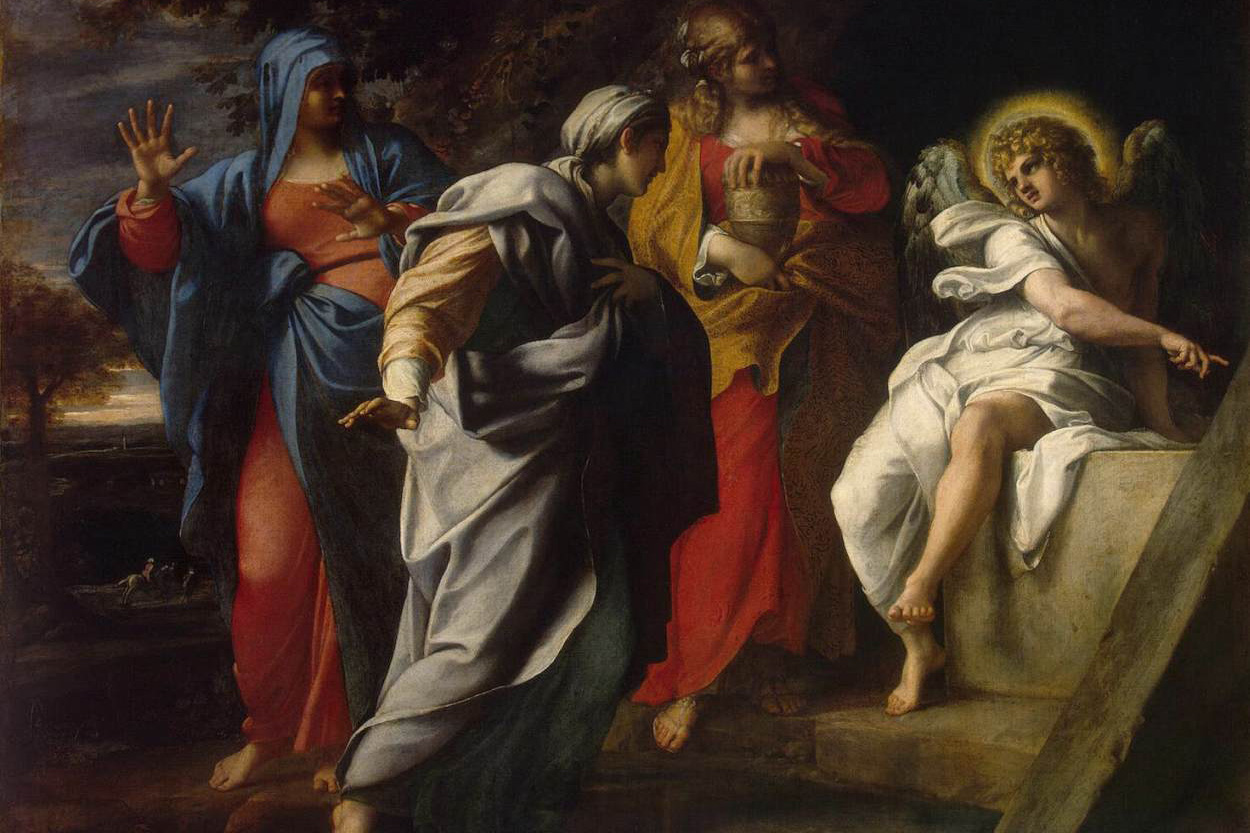
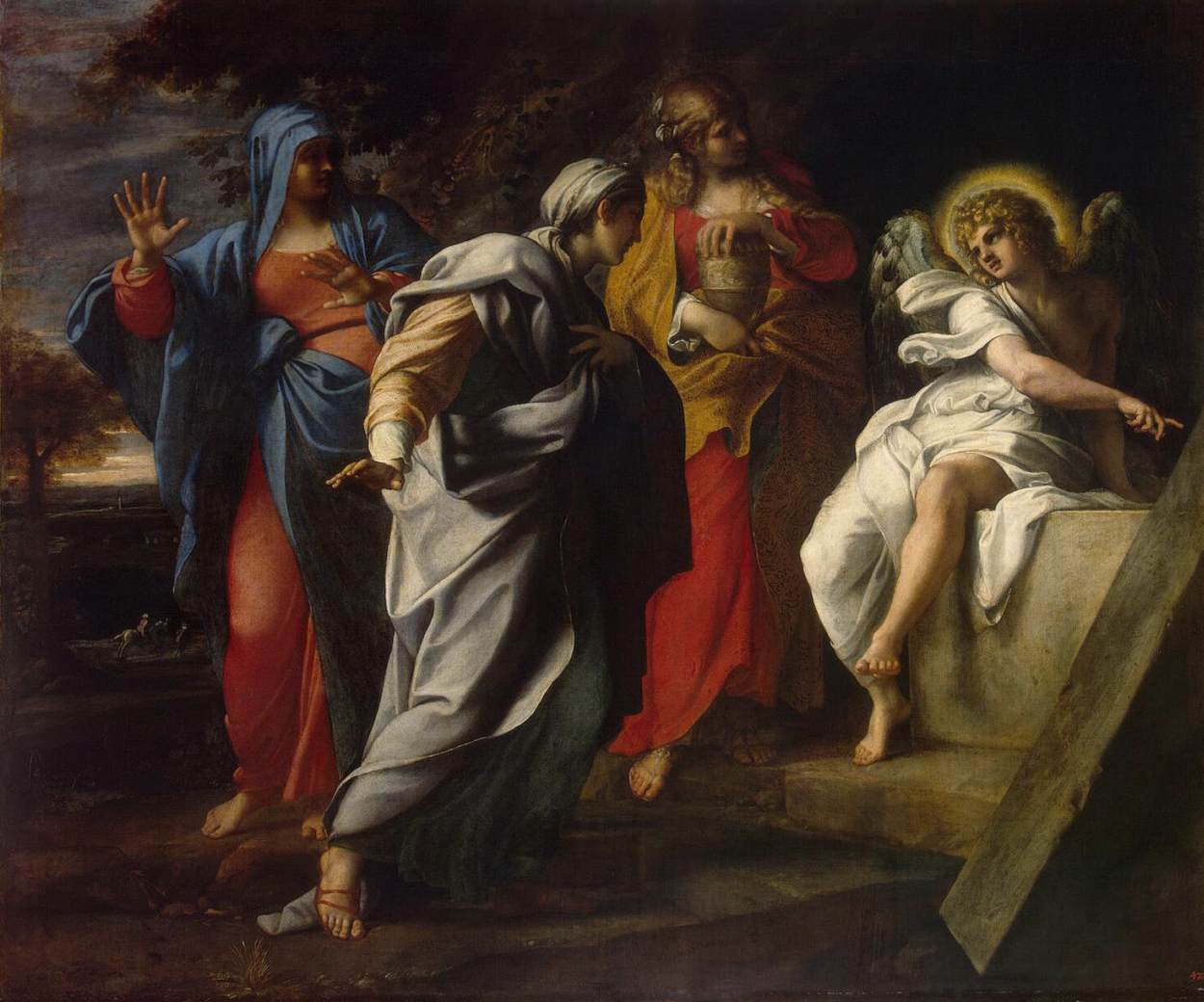
Painting above: The Resurrection by Annibale Carracci

Where Is Jesus Between His Death and Resurrection?

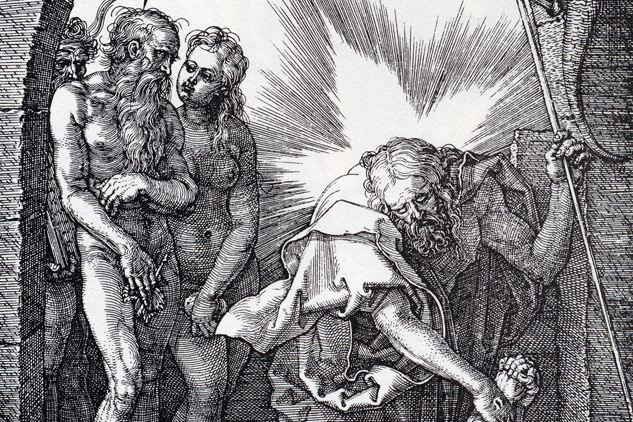
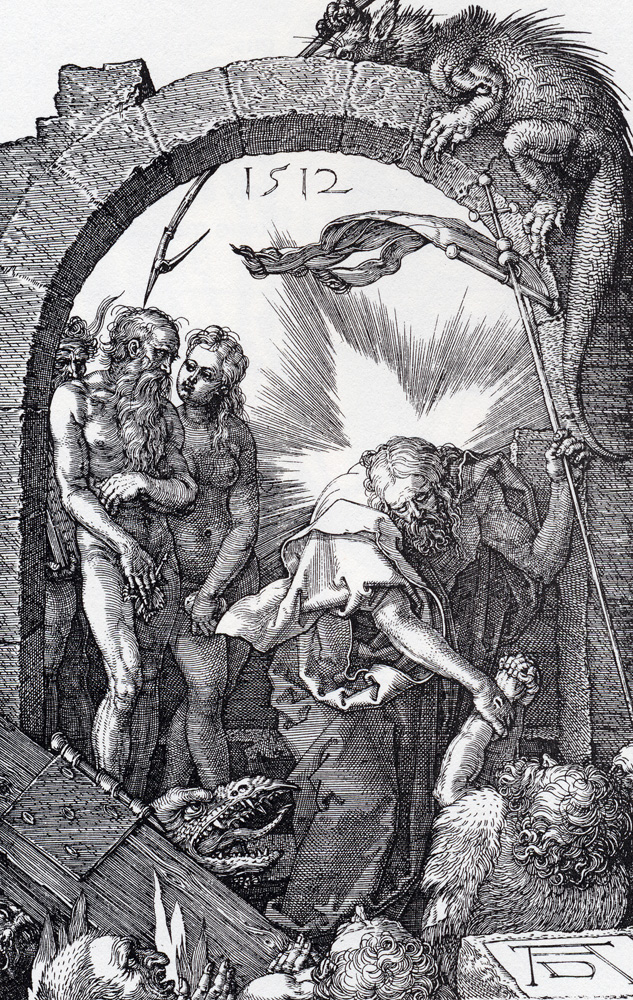
040315Where is Christ after He dies on Friday afternoon and before He rises on Easter Sunday? Both Scripture and Tradition answer this question. Consider the following excerpt from a second century sermon as well as this meditation from the Catechism of the Catholic Church.

Ancient Homily for Holy Saturday (ca. 2nd century A.D.):

Today a great silence reigns on earth, a great silence and a great stillness. A great silence because the King is asleep. The earth trembled and is still because God has fallen asleep in the flesh and he has raised up all who have slept ever since the world began. … He has gone to search for Adam, our first father, as for a lost sheep. Greatly desiring to visit those who live in darkness and in the shadow of death, he has gone to free from sorrow Adam in his bonds and Eve, captive with him—He who is both their God and the son of Eve. … “I am your God, who for your sake have become your Son. … I order you, O sleeper, to awake. I did not create you to be a prisoner in hell. Rise from the dead, for I am the life of the dead.”

Nothing could be more beautiful than that line addressed to Adam and Eve: “I am your God, who for your sake have become your Son.”

St Ephrem the Deacon also attests to this descent among the dead and describes it rather colorfully:

Death could not devour our Lord unless he possessed a body, neither could hell swallow him up unless he bore our flesh; and so he came in search of a chariot in which to ride to the underworld. This chariot was the body which he received from the Virgin; in it he invaded death’s fortress, broke open its strongroom and scattered all its treasure. (Sermo de Domino nostro, 3-4. 9: Opera edit. Lamy, 1, 152-158. 166-168)

Scripture also testifies to Christ’s descent to the dead and what He did: For Christ also suffered once for sins, the righteous for the unrighteous, that he might bring us to God, being put to death in the flesh but made alive in the spirit, in which he went and proclaimed to the spirits in prison. … For this is why the gospel was preached even to those who are dead, that though judged in the flesh the way people are, they might live in the spirit the way God does (1 Peter 3:18; 1 Peter 4:6).

The Catechism of the Catholic Church on Christ’s descent to the dead (excerpts from CCC # 632-635):

[The] first meaning given in the apostolic preaching to Christ’s descent into hell [is] that Jesus, like all men, experienced death and in his soul joined the others in the realm of the dead.

But he descended there as Savior, proclaiming the Good News to the spirits imprisoned there [cf. 1 Pet 3:18-19]. Scripture calls the abode of the dead, to which the dead Christ went down, “hell”—Sheol in Hebrew, or Hades in Greek—because those who are there are deprived of the vision of God [cf. Phil 2:10; Acts 2:24; Rev 1:18; Eph 4:9; Pss 6:6; 88:11-13].

Such is the case for all the dead, whether evil or righteous, while they await the Redeemer [cf. Ps 89:49; 1 Sam 28:19; Ezek 32:17-32; Luke 16:22-26]. “It is precisely these holy souls, who awaited their Savior … whom Christ the Lord delivered when he descended into hell” [Roman Catechism I, 6, 3].

Jesus did not descend into hell to deliver the damned, nor to destroy the hell of damnation, but to free the just who had gone before him.

[So] the gospel was preached even to the dead. The descent into hell brings the Gospel message of salvation to complete fulfillment. This is the last phase of Jesus’ messianic mission, a phase which is condensed in time but vast in its real significance: the spread of Christ’s redemptive work to all men of all times and all places, for all who are saved have been made sharers in the redemption.

Christ went down into the depths of death so that “the dead will hear the voice of the Son of God, and those who hear will live” [1 Peter 4:6]. Jesus, “the Author of life”, by dying, destroyed “him who has the power of death, that is, the devil, and [delivered] all those who through fear of death were subject to lifelong bondage” [Heb 2:14-15; cf. Acts 3:15].

Henceforth the risen Christ holds “the keys of Death and Hades”, so that “at the name of Jesus every knee should bow, in heaven and on earth and under the earth” [Rev 1:18; Phil 2:10].

Here is a recording of a sermon I preached on this topic: Where is Jesus Now.

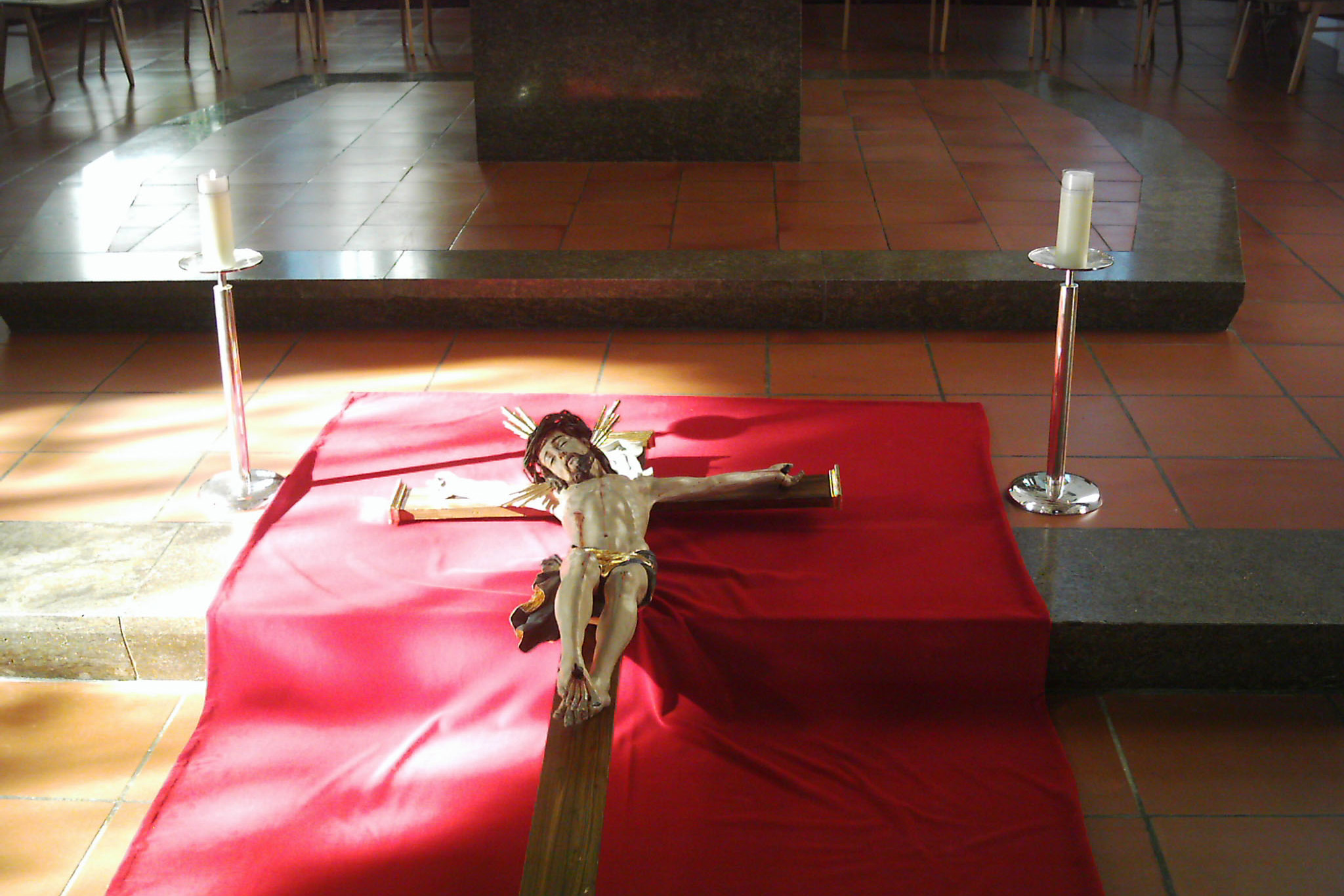
Finding the Good in Good Friday

"St.Martin-Karfreitag36" by Bene16 - eigens Werk. Licensed under CC BY-SA 3.0 via Wikimedia Commons.
“St.Martin-Karfreitag36” by Bene16 – eigens Werk. Licensed under CC BY-SA 3.0 via Wikimedia Commons.

When I was younger, and through my seminary years, I had usually seen the crucifix and Jesus’ suffering on the Cross in somber tones. It was my sin that put Him there, had made Him suffer. The Cross was something that compelled a silent reverence and suggested to me that I meditate deeply on what Jesus had to go through. I would also think of Mary, John, and the other women beneath the Cross mournfully beholding Jesus as He was slowly and painfully dying. These were heavy and somber notes but deeply moving themes.

In addition, the crucifix reminded me that I must carry my cross and go through the Fridays of my life. I needed to learn the meaning of sacrifice.

Liturgically, I also saw the crucifix as a way of restoring greater reverence in the Mass. Through the ’70s and ’80s, parishes had largely removed crucifixes, often replacing them with “resurrection crosses” or just an image of Jesus floating in mid-air. I used to call this image “touchdown Jesus” since He floated in front of the Cross with His arms up in the air as if signaling a touchdown. In those years we had moved away from the understanding of the Mass as a sacrifice and were more into “meal theology.” The removal of the crucifix from the sanctuary was a powerful indicator of this shift. Many priests and liturgists saw the Cross as too “somber” a theme for their vision of a new and more welcoming Church, upbeat and positive.

This “cross-less” Christianity tended to lead to what I thought was a rather silly, celebratory style of Mass in those years and I came to see the restoration of the crucifix as a necessary remedy to restore proper balance. I was delighted when, in the mid ’80s and later, the Vatican began insisting in new liturgical norms that a crucifix (not just a cross) be prominent in the sanctuary and visible to all, and further, that the processional Cross had to bear the image of Christ crucified (it could not just be a bare cross).

Balance Restored – I was (and still am) very happy about these new norms because they restore the proper balance in seeing the Mass as making present the once-for-all, perfect sacrifice of Jesus on the Cross. It is also a sacred meal, but it is the sacrifice that gives it its power. I also thought that such a move would help bring proper solemnity back to the Mass; to some extent this has been true.

All of this background is just to say that I saw the Cross, the crucifix, in somber, serious tones, a theme that was meant to instill solemnity and sobriety, a meditation on the awful reality of sin and our need to repent. And all of this is fine and true.

But the Lord wasn’t finished with me yet. He wanted me to see another understanding of the Cross. He wanted to balance my balance!

In effect, He also wanted me to experience the “good” in Good Friday. For while the Cross is everything described above, it is also a place of victory and love, of God’s faithfulness and our deliverance. There’s a lot to celebrate at the foot of the Cross.

It happened one Sunday in Lent of 1994, one of my first in an African-American Catholic parish. It being Lent, I expected the highly celebratory quality of Mass to be scaled back a bit. But, much to my surprise, the opening song began with an upbeat, toe-tapping gospel riff. At first I frowned. But then the choir began to sing:

Down at the cross where my Savior died,
Down where for cleansing from sin I cried,
There to my heart was the blood applied;
Glory to His name!

Ah, so this WAS a Lenten theme! But how unusual for me to hear the Cross being sung of so joyfully! (You can hear the song in the video below; try not to tap your toe too much.)

It was something quite new for me. Perhaps it shouldn’t have been but it was. The Catholicism of the ’70s and ’80s had found it necessary to remove the Cross to celebrate. But here was celebration with and in the Cross! Here was the good in Good Friday.

The Choir continued,

I am so wondrously saved from sin,
Jesus so sweetly abides within;
There at the cross where He took me in;
Glory to His name!

Congregation and choir were stepping in time and clapping, rejoicing in the Cross, seeing it in the resurrection light of its saving power and as a glorious reflection of God’s love for us. Up the aisle the procession wound and the last verse was transposed up a half-step in an even brighter key:

Oh, precious fountain that saves from sin,
I am so glad I have entered in;
There Jesus saves me and keeps me clean;
Glory to His name!

Yes, indeed, glory to His name! A lot of dots were connected for me that day. The Cross was indeed a place of great pain but also great love; there was grief but also glory; there was suffering but also victory.

Please do not misunderstand my point. There is a time and place for quiet, somber reflection at the foot of the Cross. All the things said above are true. But one of the glories of the human person is that we can have more than one feeling at a time. We can even have opposite feelings at almost the same moment!

The Balance – Some in the Church of the ’70s and ’80s rejected the Cross as too somber, too negative. They wanted to be more upbeat, less focused on sin. And so out went the Cross. There was no need to do this; it was unbalanced. For at the Cross the vertical, upward pillar of man’s pride and sin is transected by the horizontal, outstretched arms of God’s love. With strong hand and outstretched arms the Lord has won the victory for us: there at the cross where he took me in, glory to His name!

The balance is for the individual and for the Church. Some prefer a more somber meditation on the Cross to prevail while others feel moved by the Spirit to celebrate joyfully at the foot of the Cross. The Church needs both and I suppose we all need some of both experiences. Yes, it right to weep at the Cross, to behold the awful reality of sin, to remember Christ’s sacrifice. But we should rejoice, too, for the Lord has won victory for us right there: Down at the Cross. There’s a lot of good in Good Friday.

Here is the song I heard that Sunday in 1994, sung in very much the style I remember.

The Bread of Affliction: A Meditation on What Jesus Endured at the Last Supper

040115The Last Supper is, strangely, a sad study in the kind of affliction the Lord had to endure from His own disciples. Of all the meals the Lord must have shared with them, this was the one that should have gone beautifully and perfectly; it did not. From one moment to the next the blows just got worse. There were inept responses, distractions, bullheaded debates, and rebukes directed against Jesus … and then of course betrayal. It was nothing short of a disaster. The ineptitude would be almost comical if it weren’t so sad. If ever the Lord needed His disciples’ attention and understanding, it was at the Last Supper. But to a man, they let Him down. There was squabbling, misunderstanding, argumentativeness, and betrayal, all packed into one evening.

I am mindful that the unleavened bread Jesus took in His hands that evening was called “the bread of affliction.” Scripture says, You shall eat [the Passover]  with unleavened bread, the bread of affliction—for you came out of the land of Egypt in haste—that all the days of your life you may remember the day when you came out of the land of Egypt (Dt 16:3).

Indeed it was an evening of affliction! It was so awful that one could hardly have faulted the Lord for saying, “That’s it, Father. I’ve had it with them; I’m coming straight home!” Praise God that He chose to stay and die for the likes of us. And further, He takes this “bread of affliction” we dish out to Him and lifts it to the glory of the Sacrament of His Body and Blood.

Lest we be too critical of The Twelve, remember that we are often like them in many ways. Indeed, they are we and we are they. And the Lord loved both them and us to the end.

So on Holy Thursday, let’s examine the sequence of events at the Last Supper. It illustrates pretty well why the Lord had to die for us. We will see how earnest the Lord is about this Last Supper, how He enters it with an intense love for His disciples and a desire that they (we) heed what He is trying to teach them. We shall see, however, that they (we) show forth a disastrous inattentiveness and a terrible lack of concern for the Lord.

Here, then, are the movements of the Last Supper. Watch how things begin with the loving and careful attentiveness of the Lord and end with a selfish, inept, and unloving response from the Apostles (us?).

  1. COMING CLOUDS – Jesus knows that His hour has come; this will be His last meal. Judas has already conspired and been paid to hand Him over. Scripture says, Before the feast of Passover, Jesus knew that his hour had come. He always loved those who were his own, and now he would show them the depths of his love. The devil had already induced Judas, son of Simon the Iscariot, to hand him over (John 13:1). Thus in the gathering storm Jesus plans His last meal, which will also be the first Holy Mass. He instructs His Apostles to prepare the meal: He sent two of his disciples, and said to them, “Go into the city, and a man carrying a jar of water will meet you; follow him, and wherever he enters, say to the householder, ‘The Teacher says, Where is my guest room, where I am to eat the Passover with my disciples?’ And he will show you a large upper room furnished and ready; there prepare for us” (Mark 14:13-15).
  2. CARING CONCERN – This last supper was obviously important to Jesus. Luke records the heartfelt words of Jesus: And he said to them, “I have earnestly desired to eat this Passover with you before I suffer; for I tell you I shall not eat again until it is fulfilled in the kingdom of God” (Luke 22:15-16). Yes, this was to be a very special moment for Jesus.
  3. COSTLY COMMUNION – Jesus, reclining at the table, will now celebrate the Holy Eucharist for the first time. But this was to be a costly communion. He had already lost many disciples for what he taught on the Eucharist (cf John 6:50ff). After the first consecration, Jesus looks into the cup at His own blood, soon to be shed, and He distributes His own body, soon to be handed over. Yes, this is no mere ritual for Him. Every other priest before Jesus had offered a sacrifice distinct from himself (usually an animal, sometimes a libation). But Jesus the great High Priest will offer Himself; it is a costly communion.
  4. COLLABORATIVE CONDESCENSION – During the meal Jesus rises and then stoops to wash the disciples’ feet. He instructs them to see in this action a model for those who would collaborate with Him in any future ministry. John records it this way: He rose from the supper and took off his outer garments. He took a towel and tied it around his waist. Then he poured water into a basin, and began to wash the disciples’ feet, and to wipe them with the towel with which he was girded (John 13:5). Jesus then teaches the Disciples: Do you know what I have done for you? You call me Teacher and Lord; and you are right, for so I am. If I then, your Lord and Teacher, have washed your feet, you also ought to wash one another’s feet. For I have given you an example, that you also should do as I have done to you (John 13:12-15). Just moments from now, we will see them demonstrate a complete disregard for what Jesus has just tried to teach them. Now things get bad.
  5. CALLOUS CRIME– Back at table after having taught them that they must wash one another’s feet, Jesus suddenly becomes troubled in spirit and says, I tell you the truth, one of you is going to betray me (John 13:21). This causes a commotion among the Apostles, who begin to ask, “Who can it be?” As the anxiety around the table builds, Simon Peter motions to John and says, “Ask him which one he means.” Leaning back against Jesus, he [John] asked him, “Lord, who is it?” Jesus answered, “It is the one to whom I will give this piece of bread when I have dipped it in the dish.” Then, dipping the piece of bread, he gave it to Judas Iscariot, son of Simon. As soon as Judas took the bread, Satan entered into him. “What you are about to do, do quickly” Jesus told him (John 13:24-30).
  6. CONFOUNDING COMPETITION – But as Judas takes the morsel of bread and heads out into the night, no one even tries to stop him! Despite the fact that Jesus has clearly identified His betrayer, no one rises to block the door or even utters a word of protest! Why not? Luke supplies the answer: A dispute arose among them as to which of them was to be regarded as the greatest (Luke 22:24). They should be concerned about Jesus’ welfare but instead they debate which of them is the greatest. How confounding and awful! Yet is that not our history? Too often we are more concerned with our own status and welfare than with any suffering in the Body of Christ. So much that is critical remains unattended to because we are concerned with our own status, position, comfort, and welfare. Jesus had just finished teaching them to wash one another’s feet, but in an amazingly inept response, they end up arguing as to who among them is the greatest. Jesus patiently reminds them, The kings of the Gentiles exercise lordship over them; and those in authority over them are called benefactors. But not so with you; rather let the greatest among you become as the youngest, and the leader as one who serves. For which is the greater, one who sits at table, or one who serves? Is it not the one who sits at table? But I am among you as one who serves (Luke 22:25-27). Meanwhile, due to their (our) egotistical ineptitude Judas has escaped into the night.
  7. CAUSTIC CONTENTIOUSNESS – Jesus continues to teach at the Last Supper. At this moment He surely wanted to impress upon them His final instruction. How He must have longed for them to listen carefully and to deeply internalize what He was teaching! Instead, all He gets are arguments. Both Thomas and Phillip rebuke Him. John records this outrage: Jesus said, “Do not let your hearts be troubled. Trust in God ; trust also in me. In my Father’s house are many rooms; if it were not so, I would have told you. I am going there to prepare a place for you. And if I go and prepare a place for you, I will come back and take you to be with me that you also may be where I am. You know the way to the place where I am going.” But Thomas said to him, “Lord, we do not know where you are going; how can we know the way?” Jesus said to him, “I am the way, and the truth, and the life; no one comes to the Father, but by me. If you had known me, you would have known my Father also; henceforth you know him and have seen him. So Thomas rhetorically rebuked the Lord by saying, in effect, “We have NO IDEA where you are going; when will you show us the way?” Jesus answers, but Phillip will have none of this promise to see the Father and boldly says, “Lord, show us the Father, and then we shall be satisfied.” Jesus, likely saddened at all this, says to him, “Have I been with you so long, and yet you do not know me, Philip? He who has seen me has seen the Father; how can you say, ‘Show us the Father’? (John 14:1-9) His own Apostles are being argumentative and contentious. They are caustic and seem to rebuke the Lord. This supper isn’t going so well!
  8. COMIC CREDIBILITY GAP – Undeterred, Jesus embarks on a lengthy discourse (recorded by John) that has come to be called the priestly prayer of Jesus. At the end of it, the Apostles remark, perhaps ironically, perhaps with sincerity, Ah, now at last you are speaking plainly, not in any figure! Now we know that you know all things, and need none to question you; by this we believe that you came from God (John 16:29-30). But Jesus knows their praise is hollow and will not withstand the test. There is a great credibility gap in what they say, so much so that it is almost comical. So Jesus replies, Do you now believe? The hour is coming, indeed it has come, when you will be scattered, every man to his home, and will leave me alone (John 16:31-32). Peter protests, saying, Though they all fall away because of you, I will never fall away. Here is another almost comic credibility gap. Jesus says to Peter, Truly, I say to you, this very night, before the cock crows, you will deny me three times. Still insistent, Peter replies, “Even if I must die with you, I will not deny you.” And so said all the disciples (John 16:33-35). Well, you know the story, and you know that only John made it to the Cross. Their credibility was, by this time, a dark comedy.
  9. COMPASSIONATE CONSTANCY– But you also know the rest of the story. Jesus went on and died for the likes of them (us). I wonder if He had some of this Last Supper in mind when He said to the Father, “Forgive them, they know not what they do.” It is almost as if to say, “They have absolutely no idea what they are doing or thinking, so have mercy on them, Father.”

What a grim picture of us the Last Supper was! A disaster, really. But the glory of the story and the saving grace is this: the Lord Jesus Christ went to the Cross anyway. Seeing this terrible portrait of them (us), can we really doubt the Lord’s love for us?

May your Holy Thursday be blessed. I hope you will attend Mass and the Last Supper/First Mass will be made present to you. Never forget what Jesus endured!